




 English


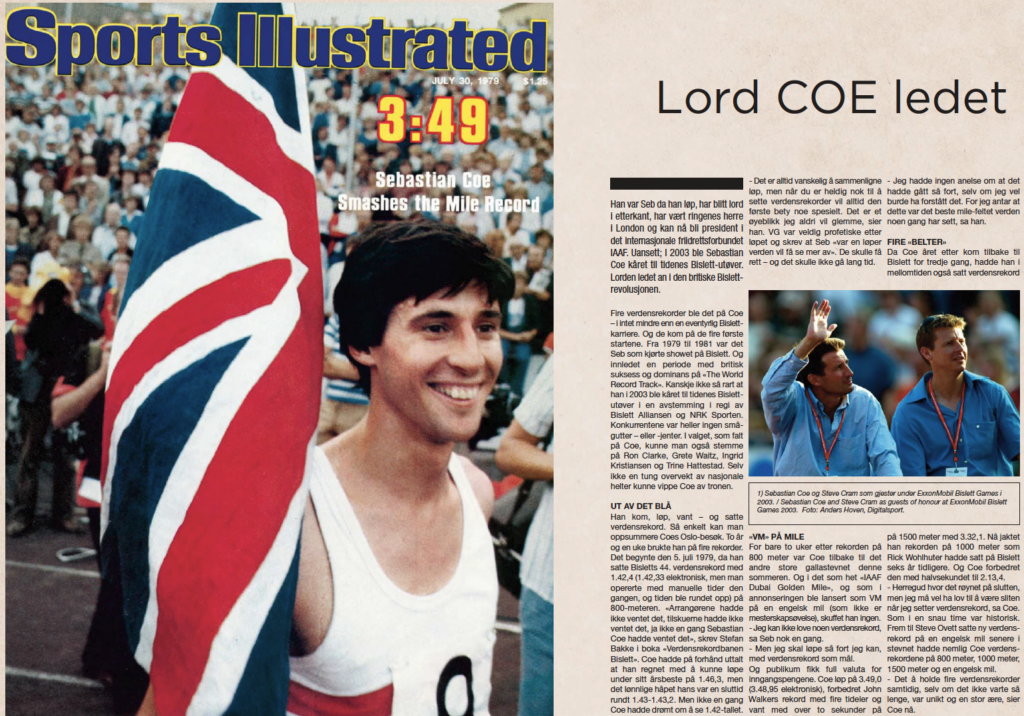
He was Seb when he ran, was knighted as Lord in 2000, chaired the organizing committee for the London 2012 Olympic Games, and today Sebastian Coe is in his eleventh year as president of World Athletics. But this is about the runner, who led the way in the British “Bislett Revolution.” This led to him being voted the greatest Bislett athlete of all time up to that point in history in 2003, in a poll organized by the Bislett Alliance and NRK Sport.
This article was first published in the commemorative book marking the first 50 years of the Bislett Games in 2015.
Four world records. An extraordinary Bislett career.
And they came in his first four appearances.
From 1979 to 1981, Seb ran the show in Oslo, ushering in an era of British success and dominance on “The World Record Track.”
Out of the blue
He came. He ran. He won. He broke the world record.
That neatly sums up Coe’s visits to Oslo. Four world records in the span of two years and one week.
It began on July 5, 1979. Bislett’s 44th world record: 1:42.4 for 800 metres.
– The organizers hadn’t expected it. The spectators hadn’t expected it. Not even Sebastian Coe had expected it, wrote Stefan Bakke in “Bislett, The World Record Track”.
Before the race, Coe had said he hoped to run under his season’s best of 1:46.3. His quiet ambition was something around 1:43.0-1:43.2. Not even Seb had dared dream of seeing 1:42 on the clock.
He slashed 1.1 seconds off Alberto Juantorena’s world record.
In 17 years, the mark had improved by just 0.9 seconds. Now it was obliterated in one emphatic swoop.
– That record will always mean something special to me, Coe said more than 35 years later.
– It’s always difficult to compare races, but when you’re lucky enough to set world records, the first will always be special. It’s a moment I’ll never forget.
The Norwegian newspaper VG proved prophetic, writing that Seb “was a runner the world would see much more of.” They were right, and it would not take long.
A World Championship Mile
Two weeks later, Coe was back for the summer’s other great gala meet – the IAAF Dubai Golden Mile, billed in advertisements as a world championship over the English mile.
– I can’t promise a world record, Seb said again.
– But I will run as fast as I can, with the world record as the goal.
The crowd got full value. Coe clocked 3:49.0, slicing four tenths off John Walker’s record and winning by more than two seconds from American Steve Scott.
En route, he passed 1500 metres in 3:32.8, 1.2 seconds inside Jean Wadoux’s European record.
– I was surprised when I was told I’d set a world record, Coe told Athletics Weekly.
– I had no idea it had been that fast, although perhaps I should have. I suppose this was the best mile field the world had seen up to that point.
Four belts
When Coe returned to Bislett the following year he had already lowered the 1500m world record to 3:32.1. Now he hunted the 1000m mark set at Bislett six years earlier by Rick Wohlhuter.
He took half a second off it: 2:13.4.
– Good Lord, it hurt at the end, but I suppose I’m allowed to be tired when I’ve set a world record, Coe said.
For nearly an hour, he stood alone in history.
Until Steve Ovett broke the mile record later that same evening, Coe simultaneously held the world records at 800m, 1000m, 1500m and the mile.
– To hold four world records at the same time, even if only briefly, was unique and a great honour, Coe later reflected.
– Especially considering the level of competition, led by Steve Ovett, one of the most gifted athletes I ever raced against.
The finest race
– I can never promise a record. I’ll run as well as I can and do everything to win. But a record …
That was Coe’s attempt to temper expectations before his fourth Bislett appearance.
Since his previous visit, he had claimed Olympic gold at 1500 metres and silver at 800 metres at the 1980 Summer Olympics, and earlier in 1981 had run a staggering 1:41.73 world record for 800 metres.
Form was not the issue.
So, it came as little surprise when 2:13.0 became 2:12.18.
Four appearances. Four world records.
Asked years later how he ranked them, Coe replied:
– All the races were different and it’s very hard to compare them. But in terms of pure athleticism, I choose the last one. It was probably the toughest race.
An unique track
Coe would add a few more appearances at Bislett in the years that followed, finishing with third place in the mile in 1985.
– I loved running at Bislett, he said back in 2015.
– The intimacy and the atmosphere made it something very special. And of course, the smell of wort down the home straight.
He was referring to the Frydenlund brewery, located just outside the stadium gates at the time.
– That wonderful smell gave you an extra lift, he said with a smile.
– A good Scandinavian summer evening is hard to beat for middle-distance running.
Sebastian Coe won two Olympic gold medals: 1500m in Moscow in 1980 and again in Los Angeles four years later at the 1984 Summer Olympics – along with two Olympic silvers at 800m. He claimed four European Championship medals, including 800m gold in Stuttgart in 1986.
In total, he set twelve world records: nine outdoors, three indoors.
Footnote:
Bislett has witnessed many great middle-distance races since. On June 15, 2023, Jakob Asserson Ingebrigtsen set the latest stadium record at 1500 metres with 3:27.95.
Yet Coe’s name remains etched into Bislett’s history. To this day, his 1000m stadium record of 2:12.18 stands as the second-fastest performance ever run at the distance.