






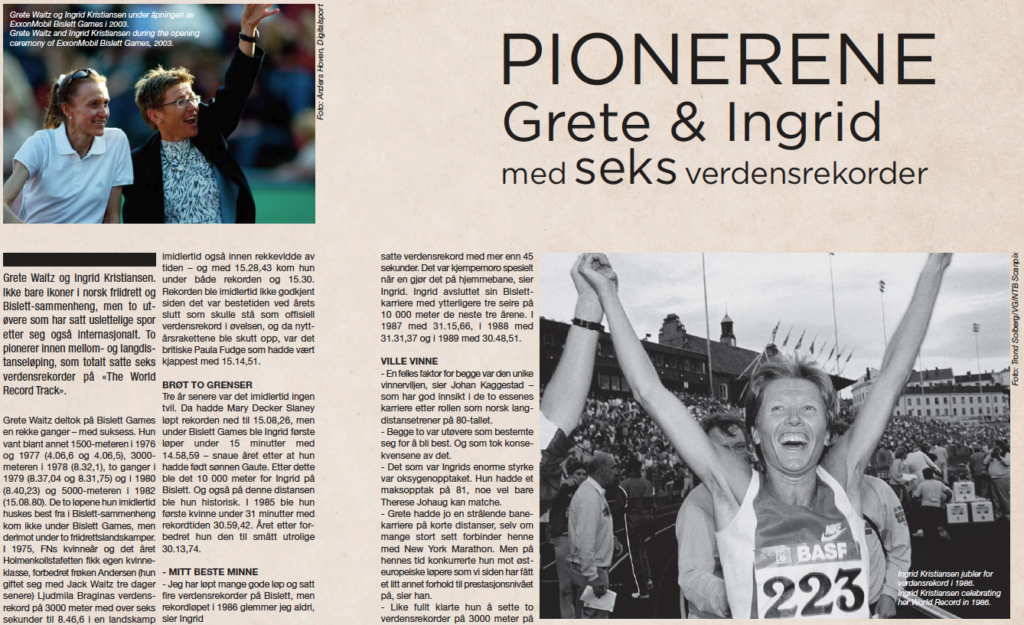
Grete Waitz and Ingrid Kristiansen.
Not only icons of Norwegian athletics and central figures in the history of Bislett, but two athletes who also left indelible marks internationally. Two pioneers of middle- and long-distance running who together set six world records on “The World Record Track”.
This article was previously published in the commemorative publication marking the first 50 years of the Bislett Games, in 2015.
Grete Waitz competed at the Bislett Games on numerous occasions – with great success.
Among other victories, she won the 1500 metres in 1976 and 1977 (4:06.6 and 4:06.5), the 3000 metres in 1978 (8:32.1), twice in 1979 (8:37.04 and 8:31.75), again in 1980 (8:40.23), and the 5000 metres in 1982 (15:08.80).
However, the two races she is best remembered for at Bislett did not take place during the Bislett Games, but rather at two international team matches.
In 1975 – the UN International Women’s Year and the year the Holmenkollen Relay introduced a women’s class – Miss Andersen (she married Jack Waitz three days later) improved Lyudmila Bragina’s world record in the 3000 metres by more than six seconds, running 8:46.6 in a match against East Germany and Sweden.
In doing so, she became Norway’s first female world record holder in athletics.
In another match the following year, this time against Denmark, she lowered the record further to 8:45.4.
Later that same year, Bragina reclaimed the record with a time of 8:27.12.
First sub 15:30
Ingrid Kristiansen was also a major attraction at the Bislett Games for many years, but unlike Grete’s records, Ingrid’s were set during the annual main event.
Her first record came in 1981, but it was unofficial. Most people agreed beforehand that Grete was the one who would attempt to break Janice Merrill’s 15:30.6 world record in the 5000 metres that day, but just over a kilometre from the finish she was forced to drop out with an injury.
Ingrid, who at that point was running 50–60 metres behind, was also within reach of the record – and with a time of 15:28.43, she broke both the record and the 15:30 barrier.
However, the record was not ratified, as the official world record at the time was determined by the fastest performance at the end of the season. When the New Year’s fireworks went off, Britain’s Paula Fudge held the record with 15:14.51.
Broke two barriers
Three years later, there was no doubt. By then, Mary Decker Slaney had lowered the record to 15:08.26, but at the Bislett Games Ingrid became the first runner under 15 minutes, clocking 14:58.59 – less than a year after giving birth to her son, Gaute.
After that, it was the 10,000 metres for Ingrid at Bislett.
And on this distance, too, she made history.
In 1985, she became the first woman under 31 minutes, with a record time of 30:59.42.
The following year, she improved it to an almost unbelievable 30:13.74.
– My best memory
– I have run many good races and set four world records at Bislett, but I will never forget the record race in 1986, Ingrid said in the interview we conducted for the commemorative publication.
– That year, it was almost taken for granted that I would set a new world record in the 10,000 metres.
– I had already set a couple of records at Bislett, so it wasn’t new to me. But that day, I really planned to run fast.
– Svein Arne (Hansen) had arranged a pacemaker, and it looked promising.
But the “pacemaker” turned out to be rather slow. She ran the first lap in over 80 seconds – more than eight seconds too slow. It was a small catastrophe, but I passed her and took control of the race, which then developed well for me.
– I caught all my competitors by one, two or three laps. It was an amazing feeling. And the Bislett crowd was just fantastic that day. I have never before or since experienced such an atmosphere at an athletics meet in this country. I broke the world record by more than 45 seconds. It was great fun – especially doing it at home, Ingrid said eleven years ago.
She ended her Bislett career with three more victories in the 10,000 metres over the next three years: in 1987 with 31:15.66, in 1988 with 31:31.37, and in 1989 with 30:48.51.
Wanted to win
– One common factor for both was their unique will to win, said the late Johan Kaggestad, who had deep insight into the careers of the two stars through his role as Norway’s long-distance coach in the 1980s.
– Both were athletes who decided they wanted to be the best – and accepted the consequences of that decision.
Ingrid’s enormous strength was her oxygen uptake. She had a VO₂ max of 81.
Grete had an outstanding track career over shorter distances, even though many mainly associate her with the New York Marathon. But in her era, she competed against Eastern European runners whose performance levels we have since come to view somewhat differently.
– Nevertheless, she managed to set two world records in the 3000 metres at Bislett, he said.
To this day, she still holds the Norwegian national record in the 1500 metres with 4:00.55.
– Also remember that the 5000 and 10,000 metres were introduced relatively late to the competition program. When Grete was at her peak as a track runner, 3000 metres was the longest distance available for women.
Negative split
– Ingrid Kristiansen set four of her five world records at Bislett and became the first woman under 15 minutes in the 5000 metres and under 31 minutes in the 10,000 metres. Still, as she herself has also said, it is probably the 1986 10,000-metre record that stands as her best track race. At the time, 30:13.74 was ground-breaking, Kaggestad said in our interview.
– Remember that she improved the world record by more than 45 seconds.
– A curious aspect of that race is that she ran what is known as a negative split, meaning the second 5000 metres was faster than the first (15:02.41 versus 15:11.33).
This was partly due to a weak pacemaker. But the BUL runner didn’t need help that evening.
She did the job on her own.
Facts: Grete Waitz
Grete Waitz won World Championship gold in the marathon in 1983 and claimed five World Championship titles in cross-country from 1978 to 1983.
She also won Olympic silver in the marathon in 1984, two bronze medals at the World Cross Country Championships, and European Championship bronze in the 1500 and 3000 metres.
She won the New York Marathon nine times.
She set numerous Norwegian records, and her 1500-metre record is still the Norwegian national record.
She improved both the Norwegian and world best in the marathon four times, down to 2:25.28, and held world best performances in several road distances.
She won seven King’s Trophies (given to one man and one women for the “best” performance at the Norwegian Championships) and 33 individual Norwegian championship titles from 800 metres up to 10 km cross-country.
She became the first woman in the world under 2:30 in the marathon when she ran 2:27.33 in 1979.
She received the Bislett Medal in 1975.
Grete Waitz died of cancer on 19 April 2011.
Facts: Ingrid Kristiansen
Ingrid Kristiansen won World Championship gold in the 10,000 metres in 1987, in cross-country in 1988, and in road-running in 1987 and 1988.
She also has three bronze medals from the World Cross Country Championships, European Championship gold in the 10,000 metres in 1986, and European Championship bronze in the marathon in 1982.
She won numerous international marathons, including Houston, London, Boston, Chicago and New York.
She set many Norwegian records, and her 10,000-metre record is still the Norwegian national record.
She set the world best in the marathon with 2:21.06 in London in 1985 – a time that is still the Norwegian best.
For a period, she also held world best performances in several road distances.
She won two King’s Thropies and 24 individual Norwegian championship titles from 1500 metres up to 10 km cross-country. She also won eight Norwegian relay championships in cross-country skiing.
She received the Bislett Medal in 1982.
By Morten Olsen